I’m a follower of Joseph Campbell, so I have a great respect for the monomyth theory. The Changeling myth shows up in its own way within diverse cultures. A loved one being replaced by an imposter is universally unsettling. Modern storytellers can’t keep their hands off it. It titillates and terrifies. And I can’t look away.
What about horror and sci-fi that captures your imagination?
Horror and sci-fi, besides being a fun ride, are mediums that explore the human condition in a unique way. They test us in extreme settings and circumstances. It amazes me how cathartic horror and sci-fi are for some people. When I read a story, I get to ask myself, what would I do? What if that happened to me? Would I be afraid?
Name one author you admire and explain how they helped you become a better writer.
Nick Cutter. He writes brilliant horror. I heard The Troop is being made into a movie. I am really looking forward to that. He was kind enough to read a sample of my work. That was quite helpful. His encouragement spurred me on in my writing process while working on, Step To It.
What about the human consciousness that fascinates you? And of course, what is the next story we can look forward to reading from you?
Human consciousness, a frontier barely explored or understood. Who are we? We hang monikers on ourselves to form identity. If you go to school, you’re a student. If you join the military, you’re a soldier. The raw material, that makes us living beings, lies beneath all that. That’s what I like to look at: what’s beneath the veneer of identity.
The next story will be a second book in the Step To It universe. I don’t want to spoil any secrets about it yet but I’m looking forward to getting it out there.
What about horror captured your imagination? When did you first hear this siren’s call?
I was really young when I was first exposed to horror. My parents liked horror and let me watch it with them, so movies like Tales From the Crypt: Demon Knight were some of my favorites as a small child. It was basically a foregone conclusion that I would like horror.
Out of all the horror you’ve read, seen, and written, what is your favorite death scene? And why?
It occurred to me with this question that I haven’t written many death scenes, probably because I don’t think dying is the worst thing I can do to a character.
My favorite in the genre is probably Paul Allen’s death in American Psycho. The violence mixed with the humor is the best. And I love seeing people beat the shit out of Jared Leto.
What inspired you to write Island X? How would you describe exploring this story and bring it to life?
Island X was inspired by a COVID vaccine-induced fever dream. I’d been watching the Fyre Fest documentaries around that same time, and so the idea was born. Exploring the story beyond that involved analyzing influencer and internet cultures. I’m not “chronically online,” so I had to do a lot of digging to get the details about summer 2022 right – until I used the Mandela Effect to change it all, of course.
Since your novel focuses on influencers, who or what had the stronger influence over your creative process? And of course, what is the next story we can look forward to reading from you?
I studied the Kardashian-Jenner clan in a semi-anthrophogical way to get a grasp on the kinds of people I was writing about. But I’d say the most positive influences for me were The Twilight Zone and The X Files.
I just finished up a manuscript about a woman who accidentally joins a mushroom-based cult and I’m in the process of querying agents, so hopefully you’ll see that soon!
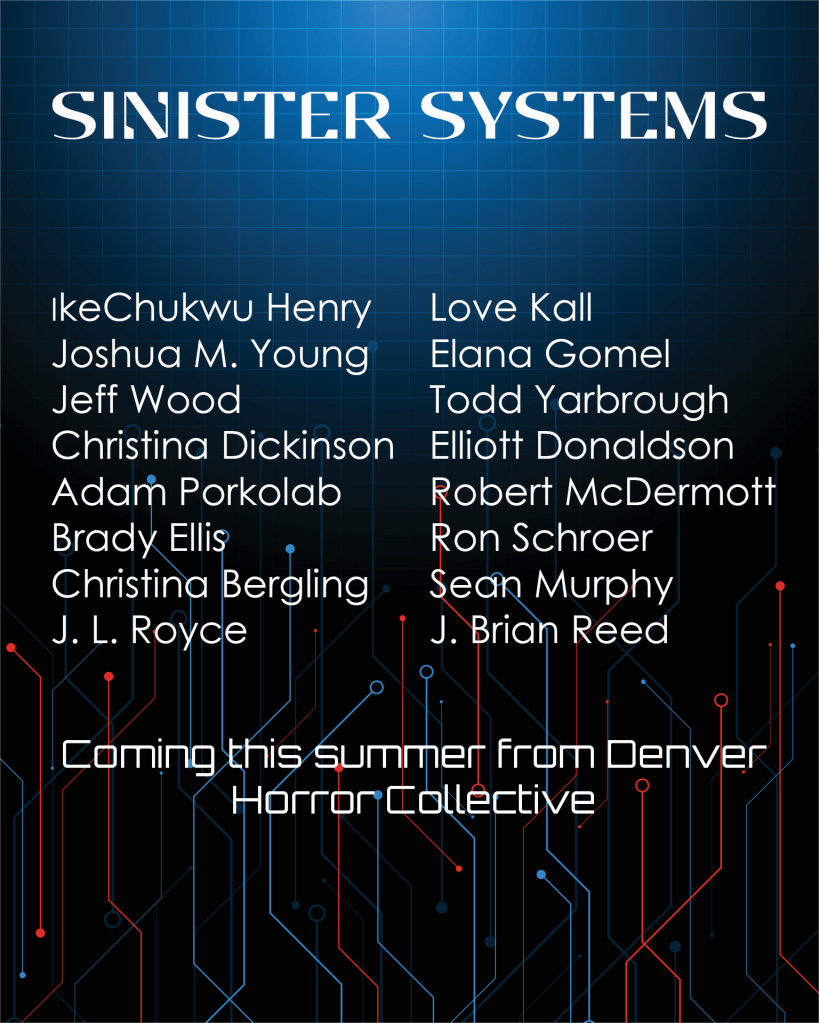
Denver Horror Collective is proud to announce the authors for its upcoming Sci-Fi Horror anthology, Sinister Systems. Featuring 16 tales across the Sci-Fi spectrum, Sinister Systems includes stories with rogue AIs, interdimensional mysteries, biological terrors, alien threats and much more. Coming out later this summer, watch our site for release details.
Name one horror author you admire and explain how they helped you become a better writer.
Every year, I discover a new author who changes my perspective on horror, and sometimes, literature and writing in general. Choose one that’s impossible. I can’t split the baby. But I can say with certainty that anyone who loves horror couldn’t go wrong reading some of my recent favorites: Steve Rasnic Tem, Attila Veres, Reggie Oliver, Mark Samuels, and Luigi Musolino.
The person who’s helped me the most become a better writer is Noah Lukeman, who doesn’t write horror at all (at least not to my knowledge).
That being said, all of my answers might be completely wrong, and I might read this interview later and say, “What the hell was I talking about?” No, not might: probably will.
What is your favorite supernatural creature? And why?
The Wandering Jew. His immortality and itinerancy make him something like a biblical cowboy. If that biblical cowboy was also a scapegoat. In terms of conceptual impact, he’s a very powerful character, though not very popular, at least not contemporarily. I think because some people are uncomfortable writing or saying the word “Jew” and others are way too comfortable writing or saying it (and not because they’re fans of the tribe).
Aesthetically, the xenomorph—what H.R. Giger calls the actual monster he designed for Alien—is pretty badass. If something looks evil enough, it can overcome the absence of evil character development in the narrative. Kind of adjunct to “Quantity has a quality all its own.”
Although the horror series The Strain also has two of my favorite villains. Thomas Eichhorst, an undead Nazi who’s hardened after betraying the Jewish woman he loves (after that, he’s all in on evil; in for a penny, in for a pound). And The Master, when his physical host was the gigantism-afflicted Jusef Sardu. A bloodthirsty giant in a holocaust cloak is pretty terrifying.
These questions are too hard. Why would you give me these impossible questions?
What is your favorite story? And why?
I don’t have one, and it’s impossible to have one, and if people claim to, if you talk to them long enough, they’ll find another story they say is just as good. And if you wait a few years, those same people will change their minds completely.
The best stories, to me, are the ones that make you set the book down on your chest after finishing, take a breath, and then register, if even only on an unconscious level, that you are no longer the same person who began reading it.
There are a few I’ve read over the last few years: “The Red Fog” by Mark Samuels, “The Amber Complex” by Attila Veres, “Whatever You Want” by Steve Rasnic Tem, “The Mortlake Manuscript” by Reggie Oliver.
But the story that really kicked my ass was “Lazarus” by Leonid Andreyev. It takes a biblical story of resurrection and turns it into a cautionary tale of cosmic dread. If “Lazarus” doesn’t freak you out, then you’ve got ice water in your veins.
What about the thrill of writing that calls your name and excites you to create a new tale? And of course, what is the next story we can look forward to reading from you?
Rarely does writing thrill me. But if I don’t write, I feel like I’m swollen with psychological edema. Writing is agony, and going back and reading your older writing is a specific, can be cringe-inducing agony.
What’s next? I’m not sure. The majority of what I write ends up abandoned and consequently unpublished. I started my writing career with three semi-competent longer works and a not-so-great novella. Although recently, I’m really enjoying writing short stories, even though they don’t give me as much space to develop character arcs or create a fictional universe, so I’ll probably keep doing that.
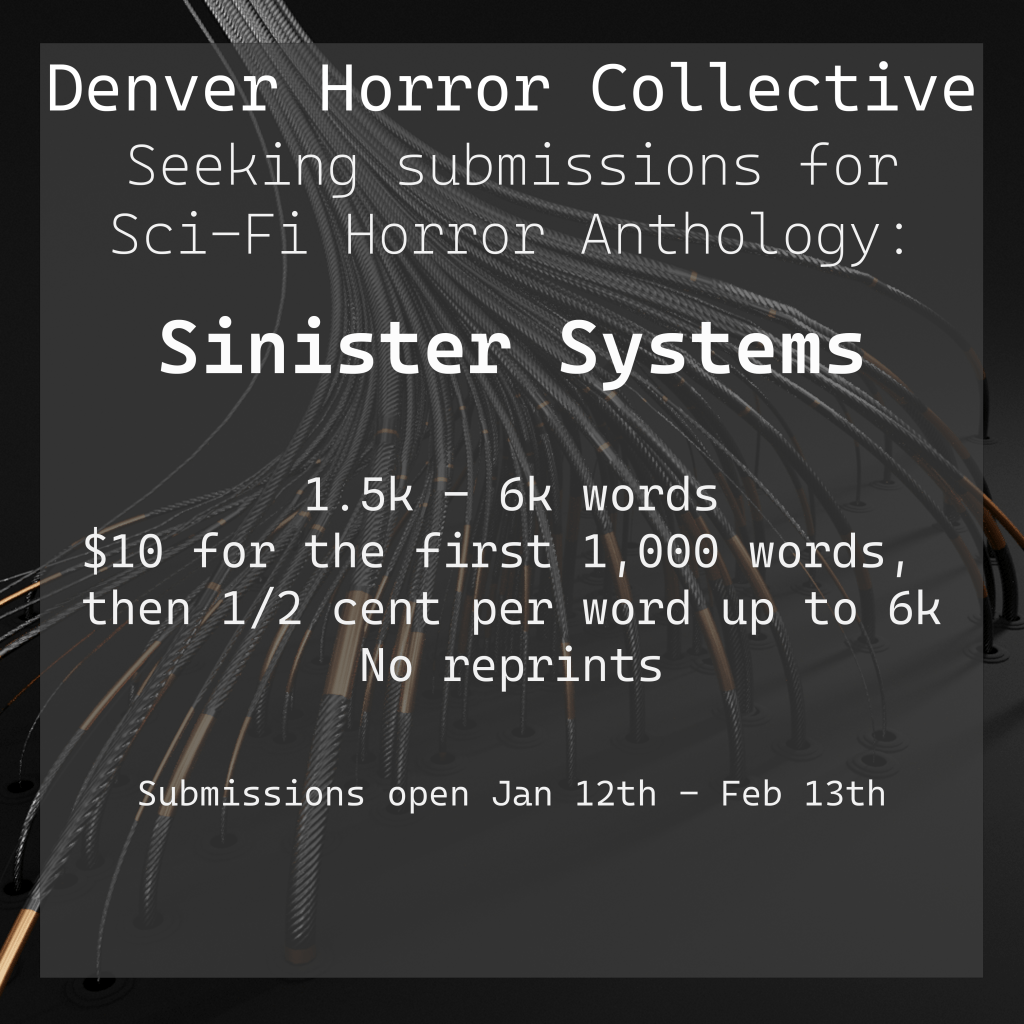
Denver Horror Collective is seeking submissions for a Science Fiction Horror anthology: SINISTER SYSTEMS. Send us your stories of first contact gone wrong, the bio weapon that escapes containment, or an AI bleeding into the real world with disastrous results. We’re looking for mad science (Resident Evil), cosmic horror (Event Horizon), incomprehensible alien life (Annihilation), and more.