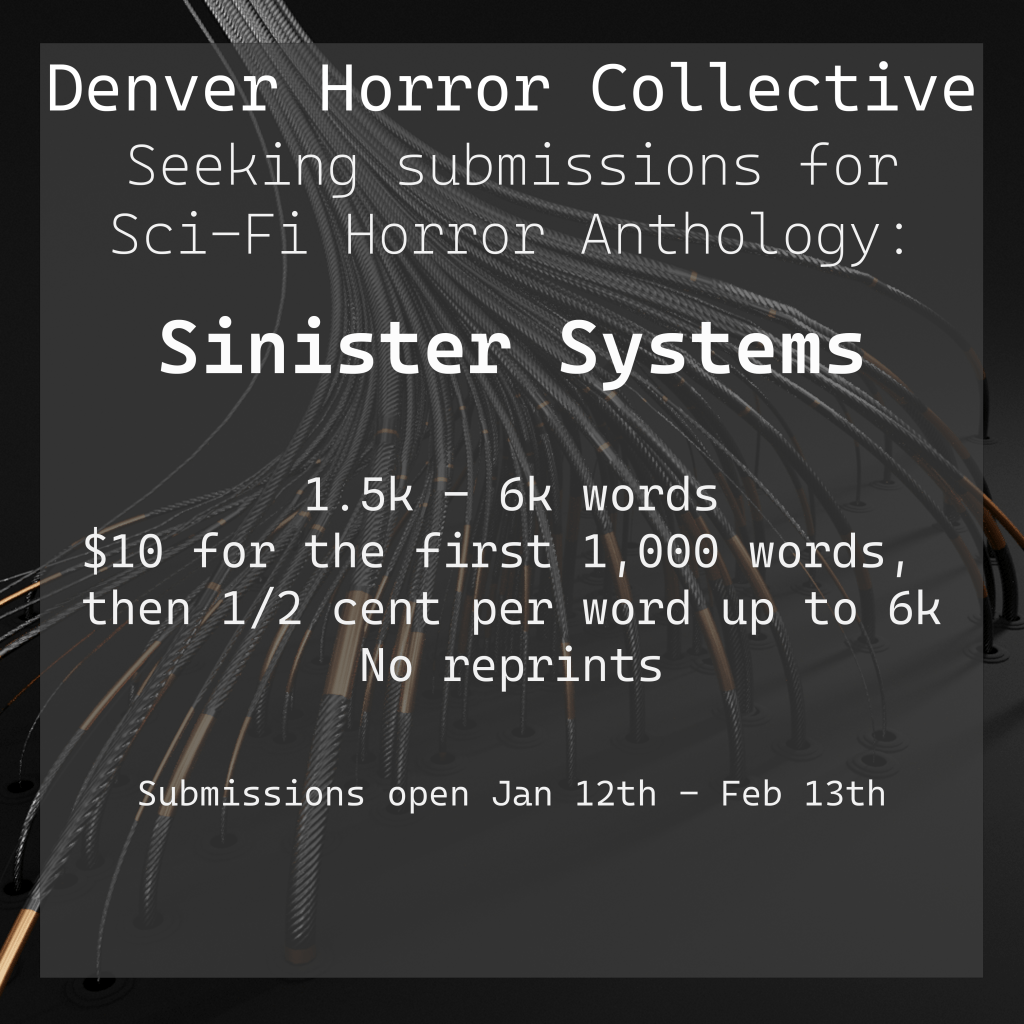
Denver Horror Collective is seeking submissions for a Science Fiction Horror anthology: SINISTER SYSTEMS. Send us your stories of first contact gone wrong, the bio weapon that escapes containment, or an AI bleeding into the real world with disastrous results. We’re looking for mad science (Resident Evil), cosmic horror (Event Horizon), incomprehensible alien life (Annihilation), and more.
Archivist Mara accepts a quiet contract to catalog the crumbling Dumont estate. She expects solitude and routine; instead she finds a house steeped in silence, where the walls listen and the mirrors shift when no one is looking. The longer she stays, the more her own reflection falters. Her memories bend, her thoughts blur, and the line between herself and the presence within the house begins to dissolve. Somewhere in its history, a woman named Isabelle Dumont was erased—and Mara senses that same fate closing in.
What haunts the estate isn’t a ghost. It’s a patient predator, practiced in the art of rewriting lives, and it has set its sights on her.
The Memory Keeper is a gothic psychological horror about coercion, haunting, and the violence of being forgotten. It’s the first novel in Rowan Taylor’s chilling new series The Oblivion Cycle— standalone horror novels united not by character or plot, but by a single devouring idea: what if identity is not a fixed truth, but prey?
Each book opens a different doorway into oblivion, revealing how the self can be stolen, rewritten, hollowed out, or willingly surrendered.
Welcome to the quiet horror of Rowan Taylor — where memories linger, love unravels, and the line between presence and absence is never quite clear. These are stories that don’t scream — they whisper, weep, and wait in the silence.
Here, hauntings are intimate. Familiar faces become unfamiliar. Rooms remember. And some doors never close.
Rowan Taylor writes unsettling fiction that blends psychological dread with the supernatural, exploring what it means to forget—and to be forgotten. She is also known as Tracy Fobes, author of eight award-winning paranormal romances published by Simon & Schuster and Leisure LoveSpell. Fobes has also independently published numerous romantic suspense stories, including Hard Charger and Billionaire’s Hidden Heart.
As Fobes, she wrote of witches, grimalkins, haunted seas, and dangerous love. As Rowan, she steps fully into the dark.
She lives near Philadelphia, owns too many books and too few flashlights, and believes the scariest monsters are the ones who know your name.
When a successful bookstore owner is abducted by a meticulous serial killer, she finds herself in a sterile cage designed for torture. But as the captor attempts to break his victim, the roles of predator and prey begin to blur. In a deadly psychological game where survival means becoming the greater monster, she must confront her own dark history to not only escape, but to take everything from the man who trapped her.
Floy Owens writes about the predators we fear, and the ones we become. Owens crafts stories where monsters wear familiar faces and victims learn to bite back. When she isn’t writing, she can usually be found with her senior dog, a cup of tea, and a stack of true crime books, researching what drives people past their breaking point.
As a writer, what would you choose as your mascot and why?
I’d choose an old, rusted key—the kind you find in the back of a forgotten drawer, heavy with a story you can feel but not name. A key without a door has always fascinated me. It promises access, but not certainty. It’s an object built for purpose, yet that purpose has been erased.
My stories constantly return to thresholds: between memory and oblivion, self and possession, past and present, what is real and what only feels real. Keys live on thresholds. They turn, they open, they lock, they deny. They force you to decide whether you’re brave/desperate enough to try them in a door you’ve never seen.
A rusted key suggests something long-hidden, something that’s waited too long for someone to find it. But it also warns you that the lock it belongs to may not want to be opened.
My stories are about crossing those boundaries, willingly or not, and discovering that the doorway was never just a passage… it was a trap, an invitation, or sometimes a mirror. And the terrifying truth is that the key isn’t always meant for a door in the world—it’s often meant for a door inside you.
That’s why a key is my mascot. It’s small, unassuming, but it changes everything once you turn it.
Name four of your favorite horror movies or books. Elaborate on any of them.
Books: Swan Song by Robert McCammon, The Stand by Stephen King, Pilo Family Circus by Will Elliott, Strangers by Dean Koontz
Movies: Alien, The Exorcist, Poltergeist, It Follows
Swan Song is a favorite of mine. There’s something amazing about the way McCammon balances apocalyptic horror with deeply human emotional stakes. His characters feel so raw, flawed, and full of grit—that the supernatural elements hit twice as hard. That blend of mythic scale and intimate character development is the type of horror that inspires me most: stories where the world is ending, but what devastates you is one person’s small, private heartbreak inside it.
I also have a deep love for Pilo Family Circus, which is one of the strangest, wildest pieces of horror fiction I’ve ever read. Will Elliott takes something familiar—fear of clowns—and pushes it into a surreal, nightmarish carnival of identity fracture. The way he externalizes a character’s inner violence and turns it into a literal alter-ego feels uncomfortably close to the themes I explore: the horror of becoming someone you don’t recognize. I am really afraid of clowns, by the way.
What terrified me most about The Exorcist was the idea of an evil, predatory super-intelligence fixating on a child with purely malevolent intent. The corruption of innocence is unsettling enough, but the film goes further: the demon isn’t after Regan alone. It wants the souls of everyone around her.
That kind of evil—without reason, without vendetta, without even the courtesy of a motive—feels especially horrifying. It’s not seeking justice or revenge; it simply wants to pervert, to torment, to drag people into despair because suffering is its nature. The idea that such a force could reach into an ordinary home and begin unmaking a family from the inside was deeply disturbing to me.
And Poltergeist has always fascinated me for a different reason. I loved the way it used science to quantify the supernatural—treating spirits not as vague folklore, but as a phenomenon with rules, patterns, and behaviors that could be studied. It made the spirit world feel startlingly real and believable. The film also suggested something I found compelling: the spirit world itself isn’t inherently evil; it simply exists. It’s the entities within it—the hungry, the lost, the malevolent—that create danger.
That framework, a supernatural realm governed by its own logic, was the first time I remember thinking: this could actually be real. It opened the door in my imagination for building my own believable worlds of the uncanny.
These stories influenced the kind of horror I write in The Memory Keeper and Croatoan: character-driven tales where the supernatural is terrifying, but the emotional unraveling is what truly haunts you. I’ve always been drawn to horror that lingers because it touches something human first.
What do you hope your fans will take away from your stories?
I hope readers walk away feeling seen in their loneliness—and unsettled by it. Horror is often described as the monster hunting you, but I’m more drawn to the moment when the monster leans in and whispers something you were already afraid to admit about yourself.
I also want readers to recognize that their fear, their anxiety, their sense of dislocation—these aren’t personal failures. They’re human experiences. We all stumble through moments where we feel unmoored or fractured. And I’m fascinated by “good” people who believe wholeheartedly in their own goodness… until they do something terrible, and then have to face the quiet aftermath of that act. How do they justify it? How do they carry it? How do they reconcile who they think they are with what they’ve done?
My stories live in that space between identity and erasure, between the self you claim and the self you can’t escape. If a reader finishes one of my books feeling emotionally moved, then I’ve done my job. I want the dread to linger, but I want the emotion to linger even longer.
What about the thrill of writing that calls your name and excites you to create a new tale? And of course, what is the next story we can look forward to reading from you?
The thrill is always the same: that moment when a character looks back at you and you realize they’re hiding a secret you haven’t uncovered yet. I don’t chase plots so much as emotional puzzles—the fractures in a person that make them vulnerable to the supernatural.
A lot of my writing comes from putting myself into the shoes of someone who is being erased—their soul thinning at the edges, their personality slipping, their emotions being rewritten or pulled away. I’m fascinated by how a person survives that kind of unraveling. What compromises do you make? What does it feel like to know that you’re slowly giving up pieces of yourself, and you can’t stop it? And what do you willingly surrender in order to stay alive—physically or emotionally?
What excites me most is watching a character step into the dark believing they understand who they are… and realizing, piece by piece, that they don’t. That discovery—painful, intimate, often devastating—is where the heart of the story lives for me.
Next up is Smithfield, the fourth doorway in The Oblivion Cycle, coming in 2026. It’s a psychological–sci-fi horror about a woman who wakes in a small town that feels perfect—too perfect—and slowly realizes that reality is bending around her memories. It’s eerie, suffocating, and deeply personal, filled with the kind of quiet dread and identity erosion that I love exploring.
Bonus question:
What is your favorite supernatural myth, creature, or urban legend? And why?
I’ve always been fascinated by Pinhead and the cenobites from Hellraiser. There’s nothing romantic, empowering, or morally understandable about them—no path to sympathy, no angle of redemption. They exist to revel in pain, to dismantle the human need to categorize suffering as something meaningful.
To me, that’s pure horror: a creature you cannot seduce, reason with, or pity. Something that meets you with perfect, elegant indifference and opens you up—literally and metaphorically—because that is its nature.
What author do you admire? And explain how they helped you become a better writer.
Ellen Hopkins. I read her books as a preteen, and I will never lose the feeling her stories gave me. The way her verse stripped everything down to raw emotion, the way I could feel every fracture in her characters’ lives, how the words on the page seemed to pulse with their pain and desperation. I wasn’t just reading a story. I was inside it, living it, feeling it in my chest.
That’s what I want for my readers. Every single time I write, my goal is to make them feel what I felt reading Hopkins. Not just entertained or intrigued, but completely consumed. I want them to close the book and still feel the story reverberating through them. Hopkins taught me that the highest achievement in storytelling isn’t a clever plot or a shocking twist. It’s making someone feel something so deeply they carry it with them long after the last page.
What is it about horror and thrillers that fascinate you? How do they influence your writing?
I’m fascinated by human nature, and horror and thrillers strip us down to our rawest selves. They reveal who we really are when we’re terrified, desperate, cornered. But honestly? I also just love scary shit. I love that tingle you get, the way your breath catches at the height of the story, when the tension is so tight you feel like you can’t breathe.
That’s the feeling I chase in my writing, and I’m not afraid to go dark and gory to get there. The visceral, physical horror amplifies that emotional intensity. I want my readers to experience that full-body reaction, that moment where the story has such a grip on them that their body responds. Horror gives me permission to push readers to that edge, to make them squirm, to make them feel in the most primal way. It’s not just about shocking people. It’s about using that raw, unflinching darkness to create a connection where story becomes experience.
What is your favorite story? And why?
It’s a story my grandma told me as a child about the one-eyed boogeyman. The details changed a little each time, but no matter how many times she told it, we (my sister and cousins) would jump and scream at the scary bits.
I think it’s my favorite because it’s a fond memory, but also because it made scary stories fun for me. It taught me that fear and joy can exist in the same moment, that being scared can be thrilling instead of traumatic. My grandma showed me that storytelling is about connection, about gathering people together and making them feel something powerful.
What about the art of storytelling excites you? And of course, what is the next story we can look forward to reading from you?
I love writing feelings. When I get a dialogue exchange just right and it hits, there’s nothing better. I love creating the unexpected, those moments where readers think they know what’s coming and then I pull the rug out from under them.
What excites me most about storytelling is that power to manipulate emotion through the smallest details. A single line of dialogue can make someone’s stomach drop. An unexpected choice by a character can reframe everything they thought they understood.
Right now I’m working on something that’s my personal challenge to make as creepy as possible. I want readers to feel like something’s crawling under their skin. I want them unsettled in a way they can’t quite name.
Bonus question: What is it about the gray areas of life that fascinate you? How does this seep into your writing and your characters?
I love morally gray characters. People who do terrible things for understandable reasons. What fascinates me is how they make you question your own morals. You believe murder is wrong, but suddenly you’re cheering them on. You’re conflicted, caught between what you know is right and what you feel is justified.
That’s the gray area I live in as a writer. My characters aren’t monsters for the sake of being monsters. They’re people pushed to extremes, making choices that should horrify you but somehow don’t. Or they do horrify you, but you understand why they made them anyway. That conflict, that discomfort readers feel when they realize they’re rooting for someone doing something unforgivable, that’s where the real horror lives. It’s not just about the gore or the scares. It’s about holding up a mirror and making readers see the darkness they’re capable of sympathizing with.


 Denver Horror Collective